
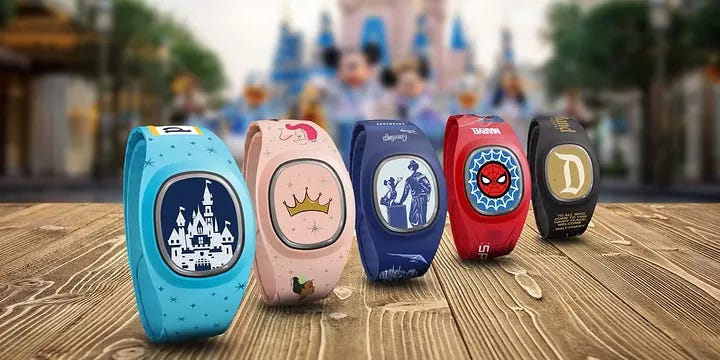
Remember when a day at a Disney theme park meant stuffing your pockets and bag with a wallet, room key (physical one or a key card), printed tickets, FastPass slips, a PhotoPass card, a physical park map, and maybe even travellers’ cheques or a pager if you’re from that era?
It became a logistical nightmare ensuring that you had everything for everyone in your party. But what happened if you forgot something? Talk about adding extra stress to your holiday.
Well, in one bold move, Disney took all of that and streamlined it into a single, wearable experience: the MagicBand.
Launched in 2013 as part of the MyMagic+ initiative, the MagicBand was more than a tech upgrade, it was a masterclass in omnichannel experience design.
The Experience Design Challenge
Disney parks were already some of the most logistically complex entertainment spaces in the world with thousands of guests navigating attractions, dining, accommodations, and transportation daily. The guest experience risked becoming more fragmented as new offerings were layered in over time.
How could guests navigate all these extra offerings without getting overwhelmed and plan ahead to ensure that everyone in their party was satisfied?
To solve this, Disney’s Imagineering team and their partners followed a process that mirrors the well known Double Diamond design model.
Research
Various research methodologies no doubtably revealed guest pain points about what people carried on their person, how they queued, how they interacted with an experience/attraction and how they made decisions would drastically affect the quality of experience in the park.

The above journey map showcases some pain points that a guest will face during their day in a park before Magic Bands were introduced.
The key parts of this were:
Guest packs for park day — What does the guest need to take with them into the parks? Similar items to the ones mentioned above but the guest will need to think about money items (cards/cash/travellers cheques), ID, room keys, snacks, park maps, cameras/PhotoPass cards etc. As you can imagine this can be a lot if there is a big number in your party.
Guest creates attraction plan — Which attraction do you go to first? Where is the attraction located? Can my child ride this attraction if there is a height requirement?
Guest waits in line — Let’s be honest, no one likes waiting in line, but if you had no idea of the wait times then the pain is felt more.
Guest buys food — As you can imagine with so many places to choose from, where do you start? What does the menu look like? Does the location offer dietary alternatives (allergies/vegetarian/vegan etc)? Where is this located? How long will the wait be for my food?
Guest buys merchandise — Where do I go to find the plush toy that I wanted? Where do I find that t-shirt that I saw on social media? Do they have stock of the item I want? Do they have my size? How much is the item I want?
From all the research, a key core design problem will have emerged.
How might we simplify the guest journey during a theme park experience by reducing what they need to carry and remember?
Ideation and Delivery
Teams naturally will have explored a variety of ideas, from digital wristbands to biometric identification to app-only solutions. The winning combination? A simple RFID band synced with a robust mobile app.
The result was the MagicBand ecosystem — integrating room access, park entry, ride reservations, photo linking, dining payments, and more, all while personalising the experience.
Having been to Walt Disney World a number of times, including working there as a cast member, it was clear to see how the introduction of the Magic Band had increased guest satisfaction.
A Seamless Ecosystem: MagicBand + App
What truly sets Disney’s solution apart is the synergy between the MagicBand and the MyDisneyExperience app. While the band acts as your physical “key to the kingdom,” the app becomes your guide, planner, and real-time dashboard.
Together, they enable:
Tap-to-enter access for parks, hotel rooms, and Lightning Lanes
Contactless payments across the resort
Location-aware notifications and itinerary reminders
Family and group planning tools
This dual-channel approach empowers guests while giving cast members access to unified guest profiles — improving service, speed, and personalisation.

Those original pain points from above had been reduced and improved upon.
Guest packs for park day — Ultimately all the guest needs to bring now is their Magic Band, phone and ID. This dramatically reduced the carry need for the guest making travelling around the park much easier. Also, this meant the average spend per guest will have risen if a guest chose to not bring any snacks into the park as they would need to purchase these once inside.
Guest creates attraction plan — Guests can now research their atrraction list from the comfort of their home or resort room. This way the guests know what attractions will be of value for their party and where to go in the park as a map is included in the MyDisneyExperience app. Planning ahead can be key to making the most of the experience in the parks.
Guest waits in line — Whilst guests still needed to wait in line (unless they have a Lightning Lane pass, previously FastPass) by showcasing the live wait times in the app, the guest is able to plan better by not needing to get to the attraction to find out this information. Now the guest can make this decision after they exit another attraction.
Guest buys food — The introduction of Mobile Ordering (part of the MyDisneyExperience app) made it so that all dietary information and pricing is available in the palm of their hand. Moreover the guest is able to purchase what everyone wants (perhaps whilst in a queue line) and then simply click “I’m here, prepare my order” when they arrive at the location.
Guest buys merchandise — Having an online catalogue of merchandise and being able to see where in the park the guest can find this is incredible useful to help navigate through the possible enless hours of trying to find that one item they really wanted and then to be disappointed that it was sold out.
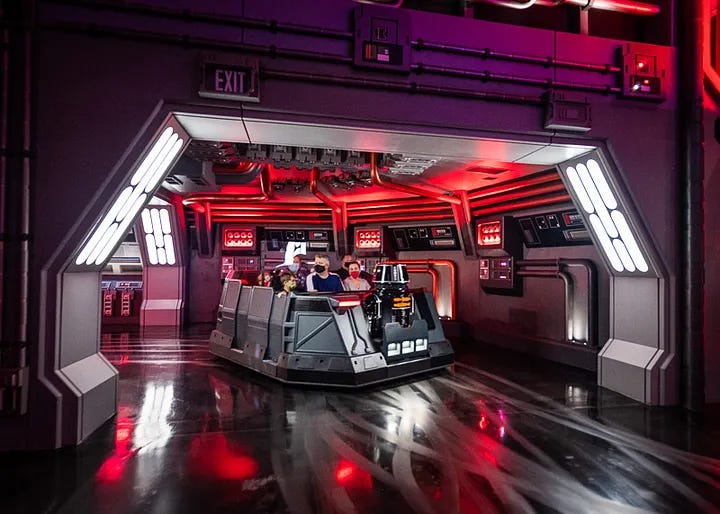
Not only this but it has opened the door to allow guests to enter into another story. A key example of this is during the queue line at Rise of the Resistance where using carefully created ‘QR codes’ the guest is able to unlock a hidden story and adventure within the attraction giving guests the opportunity to step more into the themed world.
Invisible convenience, Visible magic
For guests, the experience feels like magic. But behind the scenes, it’s a masterclass in data-driven operations:
Real-time itinerary visibility helps Disney preempt guest issues (e.g., missed reservations, underused Genie+ bookings).
Location tracking enables crowd control, dynamic wait-time adjustments, and even adaptive show timing.
Purchase history and behavior data support hyper-personalised marketing and in-park recommendations.
The trade-offs of total integration
Of course, no design is without consequences.
Data concerns: Disney effectively tracks your every move. Some guests are uncomfortable with that level of surveillance. Can the guest really decide against this? If so, how?
Loss of spontaneity: Overplanning can make a day feel rigid. Some argue the magic is lost when you’re following a digital checklist. I have seen many people following a planning system to the letter and it has created more stress and less joy.
Final thoughts
Disney’s MagicBand ecosystem illustrates what’s possible when physical and digital channels are harmonised around the guest experience not just business goals.
The MagicBand was not just a piece of wearable tech. It was an early and successful blueprint for omnichannel experience design in physical spaces, a model that experience designers across industries can still learn from today.
As we move into a future of smart environments, digital twins, and context-aware interfaces, Disney’s approach reminds us: when tech meets storytelling and thoughtful design, the magic is very real.
Key takeaways fro experience designers:
Design for ecosystems, not touchpoints — Think holistically about how each piece supports the full journey.
Prioritise seamlessness over novelty — Technology should disappear into the background, not demand attention.
Anticipate friction, then design it out — Most guest “pain points” are predictable. A great system neutralises them in advance.
Balance control with delight — Personalisation should empower, not overwhelm or restrict.